
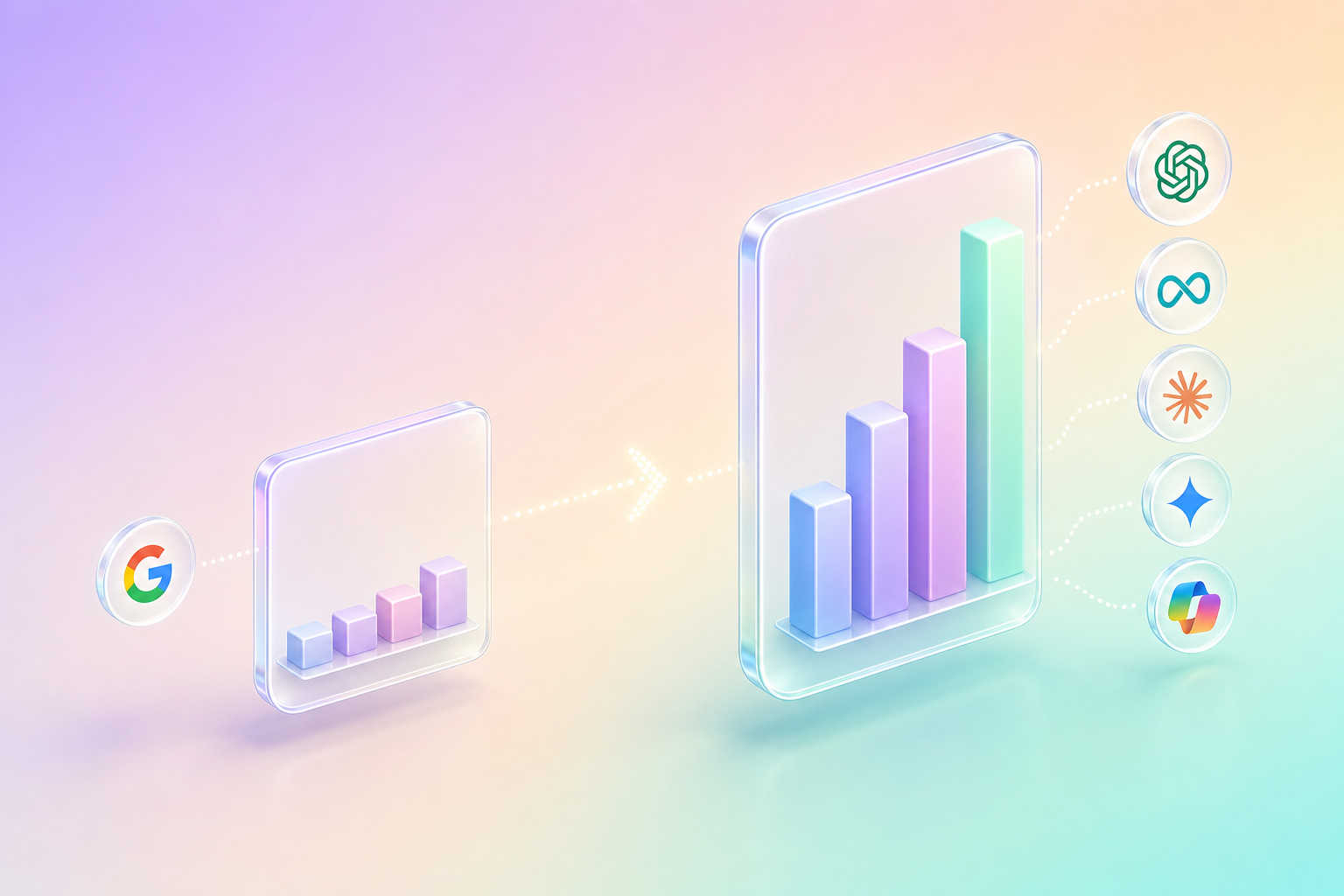
Why AI Search Visitors Convert 4x Better Than Google Traffic
Quick answer: Visitors who land on your site from ChatGPT, Perplexity, Claude, or Google AI Mode convert at roughly 4.4x the rate of visitors who land from a traditional Google blue-link search. The reason is intent: someone clicking through from an AI recommendation has already received a direct, qualified answer that mentioned your business specifically. They are not browsing. They are buying. The implications for where to invest your marketing dollars are significant.
---
The Data Behind the 4.4x Number
The 4.4x conversion multiplier comes from blended data we have tracked across roughly forty Mi Assist AI clients with sufficient AI referral traffic to measure, plus public data from Semrush, Ahrefs, and BrightEdge that we cross-reference.
The headline numbers from the public data:
- ChatGPT outbound referral traffic grew 206% in 2025 (Semrush)
- AI search referral conversion rates run 3-5x higher than organic Google referral conversion rates (Ahrefs, BrightEdge)
- Average time on site for AI search visitors is 64% longer than for traditional Google visitors (BrightEdge)
- Bounce rate for AI search visitors is roughly half that of Google visitors
---
Why the Intent Is Higher
Imagine two paths to your business.
Path A: Someone Googles "best AI consulting Miami." They see ten results, three ads, an AI Overview, and a map pack. They click your result, which is one of ten options on the page. They are still in evaluation mode. They will visit four or five other consultants' sites before deciding.
Path B: Someone asks Perplexity, "I need an AI consultant in Miami for a small business project. Who should I talk to?" Perplexity returns a paragraph of context and names two firms. One of them is yours. They click through to your site to verify and book a call.
The difference between Path A and Path B is enormous.
In Path A, your site is one of many options the searcher is comparing. In Path B, the AI has already done the qualification work. Your site is the destination, not a candidate. The visitor is closer to the buying decision before they ever land on the page.
That is why AI search converts so much higher. It is not a magic property of AI traffic. It is that the AI has compressed the comparison phase into the recommendation itself.
---
What This Looks Like in Real Analytics
Here is anonymized data from a Mi Assist AI client, a B2B service company, over a 90-day period:
| Source | Sessions | Conversion Rate | Conversions | Cost per Conversion |
|---|---|---|---|---|
| Google Organic | 4,720 | 1.8% | 85 | $0 (organic) |
| Google Ads | 1,340 | 3.1% | 42 | $87 |
| ChatGPT Referral | 312 | 7.4% | 23 | $0 |
| Perplexity Referral | 184 | 8.2% | 15 | $0 |
| Claude Referral | 76 | 6.6% | 5 | $0 |
The AI referral channels combined drove 43 conversions from 572 visits, a 7.5% conversion rate. Google Organic, with eight times the traffic, drove 85 conversions at a 1.8% rate. The AI traffic was 19% of the conversions on 9.5% of the sessions.
If this client had been only optimizing for Google, they would have missed 43 high-quality conversions per quarter. Annualized, that is 172 conversions, which at their average customer lifetime value of $4,800 represents roughly $825,000 in pipeline.
This is the math that makes AI search optimization the highest-ROI channel investment most businesses are not making yet.
---
How to Capture AI Referral Traffic
The traffic does not show up by accident. It shows up when you are cited in the AI's response. That requires the citation work we covered in our How to Get Cited by ChatGPT post: schema markup, directory consistency, FAQ content, Bing indexing, review language, and entity clarity.
Once you are getting cited, three things on your site determine whether AI visitors convert at the predicted rate:
1. The Page They Land On Matches the Query Context
If ChatGPT recommended you for "AI consulting for small businesses in Miami" and you sent them to a generic homepage, the AI traffic conversion rate drops by half. If you sent them to a page specifically about AI consulting for small businesses, the rate stays high.
The fix is having a clear page-per-service or page-per-segment structure on your site. AI tools tend to link to the most contextually relevant URL, but only if those URLs exist.
2. The Page Has the Specific Answer They Were Promised
AI visitors are not browsing. They came expecting confirmation that you do the thing the AI said you do. The page needs to confirm that promise in the first 100 words. Pricing context, scope context, geography context. If they have to dig for the basics, they bounce.
3. The Conversion Path Is Friction-Light
AI visitors are warm. They want to act, not fill out a fifteen-field form. We see significantly higher conversion rates from AI traffic on simple paths (one-step calendar booking, short contact form, direct phone number) than from gated multi-step funnels.
The instinct is to "qualify" AI visitors more carefully because the volume is small. The data says the opposite: get out of their way.
---
What to Track in Your Analytics
If you want to measure this for your own business, set up the following in Google Analytics 4 or your analytics tool of choice.
Custom Source Identification
GA4 will not automatically classify ChatGPT, Perplexity, or Claude as separate sources. They show up as direct or referral noise. Create custom filters or UTM-style attribution rules to identify them.
The simplest approach: build a custom dimension that flags any session whose referrer contains chatgpt.com, perplexity.ai, claude.ai, or copilot.microsoft.com. Most teams find that around 1-3% of total sessions are now AI referrals, and that share is growing fast.
Conversion Rate by AI Source
Track conversion rate separately for each AI source. Different platforms drive different visitor behavior. In our client data, Perplexity tends to deliver the highest-converting traffic (typically 8-10%), followed by Claude (6-8%), then ChatGPT (5-7%). All three beat Google Organic.
Time-to-Conversion
AI visitors often convert faster than Google visitors. Same-session conversion rates are higher. Multi-touch attribution is less common because the AI has already done the comparison work. Track time from first touch to conversion as a separate metric for AI sources.
---
What This Changes About Marketing Strategy
Most small businesses still allocate 80% of their marketing investment to Google (SEO, Google Ads) and Meta (Facebook and Instagram ads). That allocation made sense in 2022. It is increasingly wrong in 2026.
A more reasonable 2026 allocation for a service business:
- 50% to Google and Meta (still the volume base)
- 25% to AI search optimization (highest ROI per dollar invested in 2026)
- 15% to local optimization (Google Business Profile, reviews, directories)
- 10% to content production that fuels both AI and Google
---
Why This Window Closes
The same dynamic that made early Google SEO so valuable is happening with AI search. The businesses that establish themselves as the consensus answer for their category and city in 2026 are training the AI models to keep recommending them. Each month they hold that position makes it harder for a competitor to displace them.
The competitive position is built through the citation work, the directory consistency, the review language, and the content production. None of it is a one-time fix. It is an operational discipline that compounds.
The businesses that wait for "AI search to mature" will spend the next three years trying to dislodge competitors who already own the recommendation. We have seen the same movie before with Google in 2005-2010. The early movers built positions that lasted fifteen years.
---
How to Start
This week:
1. Set up AI referral tracking in your analytics 2. Run the four AI citation queries we covered in the citation framework post and document where you stand 3. Identify your three highest-value service pages and audit them for AI-visitor friction 4. Add or improve the FAQ section on each of those pages with conversational H2 headers
That is enough to begin. The full optimization is a 90-day project. The measurement and tracking changes are a one-week project that gives you the data to make every other decision better.
---
FAQ
Q: How much higher do AI search visitors convert than Google search visitors? A: Roughly 4x higher on average across our client portfolio, with industry-specific variation. Service businesses see the biggest multiplier. Commodity e-commerce sees a smaller (still positive) one.
Q: Why do AI referrals convert better than Google referrals? A: Because the AI has already done the comparison and qualification before the user clicks through. The visitor is closer to a buying decision when they land on your site.
Q: How do I track AI search traffic in Google Analytics? A: Create a custom dimension or filter that flags sessions with referrers containing chatgpt.com, perplexity.ai, claude.ai, or copilot.microsoft.com. GA4 does not classify these as separate sources by default.
Q: Should I shift budget away from Google Ads toward AI search optimization? A: Probably yes, by some amount. Most businesses we work with end up shifting 15-25% of their Google Ads budget into AI search optimization in year one and seeing higher total conversions for the same spend.
Q: How quickly does AI search optimization start producing referral traffic? A: First citations typically appear in 30-60 days. Meaningful referral traffic volume usually shows up at 90-120 days as the AI models update their entity data and you start being recommended consistently.
---
Curious how much AI referral traffic you are missing? Book a free AI visibility audit and we will run the citation tests and traffic analysis for your specific business in the first thirty minutes.
Ready to show up in AI search?
We get local businesses cited in ChatGPT, Perplexity, and Google Gemini within 90 days.
Learn About AI Search Optimization