
Custom AI Agents vs. Off-the-Shelf Tools: Which Is Right for Your Business?
Quick answer: Off-the-shelf AI tools (ChatGPT Team, Microsoft Copilot, GoHighLevel native AI) work well for general-purpose tasks like research, drafting, basic FAQ response, and simple scheduling. Custom AI agents are required when you need proprietary data integration, multi-step decision logic, deep integration with existing systems, or compliance-controlled deployment. Most businesses end up needing both. The decision matrix in this post explains which workflow goes where.
---
The Three Paths and Their Honest Trade-Offs
Every business considering AI implementation faces the same three choices, and most try to pretend it is two.
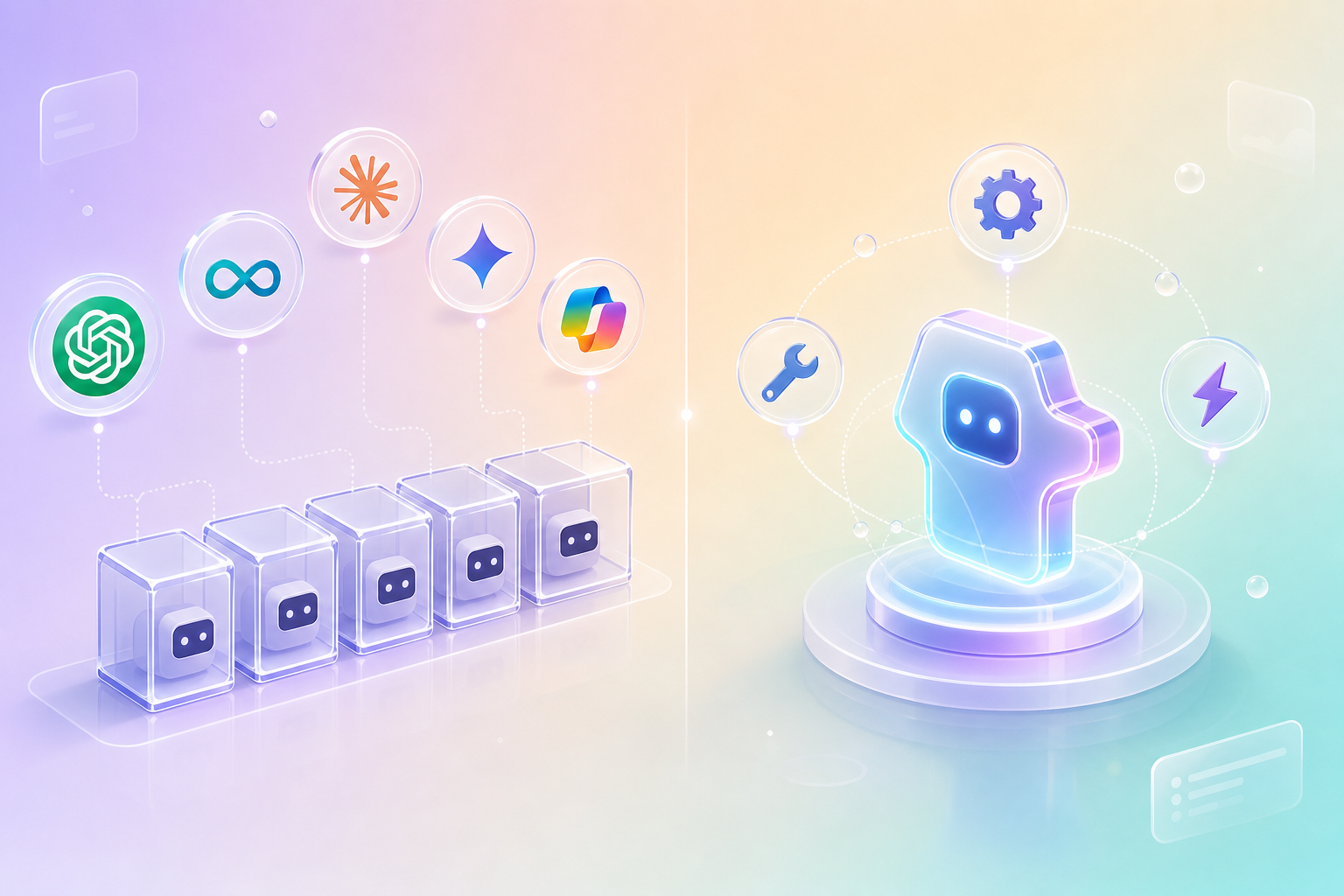
Path 1: Pure off-the-shelf. Subscribe to ChatGPT Team, Microsoft Copilot, or a similar tool. Use it as-is. Cost: $25 to $60 per user per month. Time to deploy: a week.
Path 2: Pure custom. Build agents from scratch using the model APIs (Claude, GPT-4) plus orchestration layers (LangChain, custom code) integrated directly with your specific systems. Cost: $40,000 to $250,000 in year one. Time to deploy: 90 days to 9 months depending on scope.
Path 3: Hybrid. Off-the-shelf for general productivity. Custom for specific high-value workflows. This is what works for most businesses we work with at Mi Assist AI.
The framing most vendors push is binary: either ChatGPT solves everything or you need a six-figure custom build. Neither is true for most businesses. The hybrid model is what actually scales.
---
When Off-the-Shelf Is Enough
Off-the-shelf tools handle a specific set of workflows beautifully. Use them for:
General Research and Drafting
Marketing teams using Claude or ChatGPT for blog drafts, ad copy variations, and email outlines. The work is general, the output needs human polishing, and the cost is small per use. There is no business case for a custom build to do this.
Internal Knowledge Lookups (When Your Knowledge Is Generic)
If your team's questions are mostly answerable from public knowledge ("what is the standard format for an executive summary?"), off-the-shelf works. The custom build only earns its keep when your team is asking questions that require company-specific knowledge.
Single-Document Tasks
Summarizing a transcript, extracting facts from a PDF, drafting a response to a single email. These are one-shot tasks where context is supplied at runtime. Custom builds add no value because there is no proprietary data layer to integrate with.
Simple FAQ Response
If your customer-facing FAQ is twenty common questions with stable answers, ChatGPT or a basic chatbot widget can handle it adequately. The custom build only earns its keep when your FAQ has hundreds of questions, requires data lookups (account status, order details), or needs to escalate intelligently.
---
When Custom Is Required
Custom AI agents earn their cost when at least one of these conditions is true.
Proprietary Data Integration
Your assistant needs to answer questions using your specific documents, your customer data, your operational history. Off-the-shelf tools cannot reach this data without significant custom integration work. At that point you are building a custom agent anyway, with extra constraints.
Examples: a law firm searching its own historical briefs and contracts, a medical practice referencing its specific clinical protocols, a financial advisor pulling client portfolio data into an analysis.
Multi-Step Decision Logic
The workflow involves more than a single question and answer. It needs the agent to make decisions, take actions in external systems, evaluate results, and proceed conditionally. Off-the-shelf chat tools are not designed for this. They respond to inputs but do not orchestrate multi-step processes with rollback and error handling.
Examples: a voice agent that handles an inbound call, qualifies the caller, checks calendar availability, books an appointment, sends confirmation, and triggers the right downstream workflow based on call type. Off-the-shelf can do pieces. Custom orchestrates the whole sequence reliably.
Deep Integration With Existing Systems
The agent needs to read from and write to your CRM, calendar, billing system, ticketing system, internal databases. Off-the-shelf tools have generic integrations that handle the easy 60% of this. The hard 40% (your custom CRM fields, your unique workflow states, your specific ticket categories) requires custom work.
Examples: an agent that needs to read GoHighLevel custom fields, update a custom property in HubSpot, create a record in a proprietary case management system, and trigger a Slack notification with the right routing logic.
Compliance-Controlled Deployment
Your industry or your specific data sensitivity requires that data not leave your environment. Cloud-based off-the-shelf tools are typically off the table.
Examples: law firms with Florida Bar Rule 4-1.6 confidentiality obligations, healthcare practices with HIPAA-protected data, finance firms with client data covered by SEC or Florida finance regulations. The right architecture here is on-premise deployment using tools like OpenClaw, our local AI system, which runs entirely on the client's hardware.
Brand-Specific Voice and Behavior
The agent needs to consistently represent your brand in customer-facing interactions with specific tone, style, and policy adherence. Off-the-shelf chatbots can be configured but consistency degrades over long conversations. Custom agents with carefully designed system prompts and ongoing tuning maintain quality.
Examples: a high-end hospitality brand whose voice agent must sound exactly like their concierge team, an enterprise B2B brand whose AI sales agent must follow exact qualification criteria.
---
The Build vs. Configure vs. Configure-With-Custom Decision Matrix
We use this matrix during the discovery phase of every Mi Assist AI engagement.
| Workflow Trait | Off-the-Shelf | Configured Off-the-Shelf | Custom |
|---|---|---|---|
| Uses public knowledge | Yes | Yes | Overkill |
| Uses company-specific data | No | Limited | Yes |
| Single-step task | Yes | Yes | Overkill |
| Multi-step orchestration | No | Limited | Yes |
| Generic CRM integration | Yes | Yes | If complex |
| Custom system integration | No | Limited | Yes |
| Cloud deployment OK | Yes | Yes | Yes |
| On-premise required | Rarely | Limited | Yes |
| Quality must be brand-grade | No | Limited | Yes |
| High volume (1000+ runs/day) | Yes | Yes | Best |
| Ongoing tuning needed | Difficult | Moderate | Best |
Most businesses end up with two to four custom agents (the high-leverage workflows) and broad off-the-shelf usage for everything else.
---
What Custom Actually Costs
The pricing range for custom AI agents in 2026 has settled at predictable levels.
Simple Custom Agent
A single voice agent or workflow agent integrated with one external system (a CRM or calendar). Configuration, prompting, and integration work plus a 30-day stabilization period.
- Build: $8,000 to $20,000
- First-year operation (cloud): $300 to $800 per month
- Total year one: $12,000 to $30,000
Mid-Complexity Custom Agent
Multi-step orchestration agent integrated with three to five external systems. Custom prompts, retrieval logic, escalation rules, monitoring, and tuning.
- Build: $25,000 to $60,000
- First-year operation: $800 to $2,500 per month
- Total year one: $35,000 to $90,000
Complex Custom Agent or Multi-Agent System
Internal AI assistant trained on extensive document corpus, custom multi-agent orchestration, on-premise deployment via OpenClaw or equivalent, integration with a stack of internal systems.
- Build: $80,000 to $250,000
- First-year operation: $3,000 to $10,000 per month
- Total year one: $120,000 to $370,000
Off-the-Shelf for Comparison
ChatGPT Team or Microsoft Copilot for a 50-person company.
- Build: $0 to $5,000 (rollout coordination)
- Annual cost: $15,000 to $36,000
- Total year one: $15,000 to $41,000
---
How to Sequence the Build
The mistake most businesses make is trying to go fully custom on day one. The fastest path to ROI is sequenced.
Months 1-2: Deploy off-the-shelf broadly. ChatGPT Team or Copilot for the whole company. Train the team. Establish baseline productivity gains.
Months 2-4: Identify the workflows where off-the-shelf hits its limits. Run the custom decision matrix on each. Pick the top one or two for custom build.
Months 4-7: Build the first custom agent. Integrate, test, run pilot, scale.
Months 7-12: Build the second and third custom agents. By the end of year one you have broad off-the-shelf adoption plus three to four high-leverage custom systems running in production.
This sequence is what we run with most Mi Assist AI engagements. The total year-one investment lands between $40,000 and $200,000 depending on company size and custom scope, with year-two ROI consistently above 5x.
---
Common Mistakes
Mistake 1: All-or-Nothing Thinking
"We need to decide whether to use AI tools or build custom." No, you do not. Use both. Off-the-shelf for the broad, custom for the high-leverage.
Mistake 2: Custom-First Without Foundation
Hiring a custom agent build before the team has even adopted ChatGPT Team. The custom build has nothing to compare against and the team has no fluency to operate it. Foundation first.
Mistake 3: Off-the-Shelf for Everything
Trying to make ChatGPT do work that requires custom integration. The result is fragile workarounds that break when the data changes. Recognize when a workflow needs custom and commit to it.
Mistake 4: Building Custom Without an Owner
Custom agents need ongoing tuning. Without a named owner, they degrade. We covered this in our internal AI assistant post but it applies equally to customer-facing agents.
---
When Mi Assist AI Builds Custom
The work we focus on is the custom and configured-custom layer. We do not sell ChatGPT Team subscriptions. We help businesses identify which workflows need custom, design the architecture, build the systems, and operate them.
Typical engagements run 90 days to 9 months depending on scope. We work primarily with Miami-based businesses (we are at 218 NW 24th St Suite 302) and clients nationwide who need boutique implementation rather than Big 4 consulting.
---
FAQ
Q: What is the difference between an AI agent and a chatbot? A: A chatbot responds to inputs with answers. An agent pursues outcomes by making decisions and taking actions across multiple systems. Chatbots are a subset of AI tools. Agents are a category of AI system that includes chatbots as a component.
Q: When should I build a custom AI agent instead of using ChatGPT? A: When the workflow requires proprietary data integration, multi-step orchestration, deep integration with your existing systems, on-premise deployment, or brand-specific behavior that ChatGPT cannot maintain. If none of those apply, off-the-shelf is the better choice.
Q: How much does a custom AI agent cost? A: $12,000 to $30,000 for a simple custom agent in year one, $35,000 to $90,000 for a mid-complexity build, and $120,000 to $370,000 for complex multi-agent systems with on-premise deployment.
Q: Can I start with ChatGPT and migrate to custom later? A: Yes, and this is what we recommend. Start broad with off-the-shelf, identify the workflows that hit limits, build custom for those specifically. Most businesses end up with a hybrid stack.
Q: What tools do you use to build custom AI agents? A: We use Claude and GPT-4 class models for the language layer, custom orchestration code (Python, TypeScript) for multi-step logic, ChromaDB or Qdrant for vector storage, and tools like OpenClaw for on-premise deployments. Stack choice depends on the use case.
---
Need help deciding which workflows should be custom? Book a free assessment and we will run the decision matrix on your top five workflow candidates and recommend a sequenced 90-day plan.
Ready to show up in AI search?
We get local businesses cited in ChatGPT, Perplexity, and Google Gemini within 90 days.
Learn About AI Search Optimization