
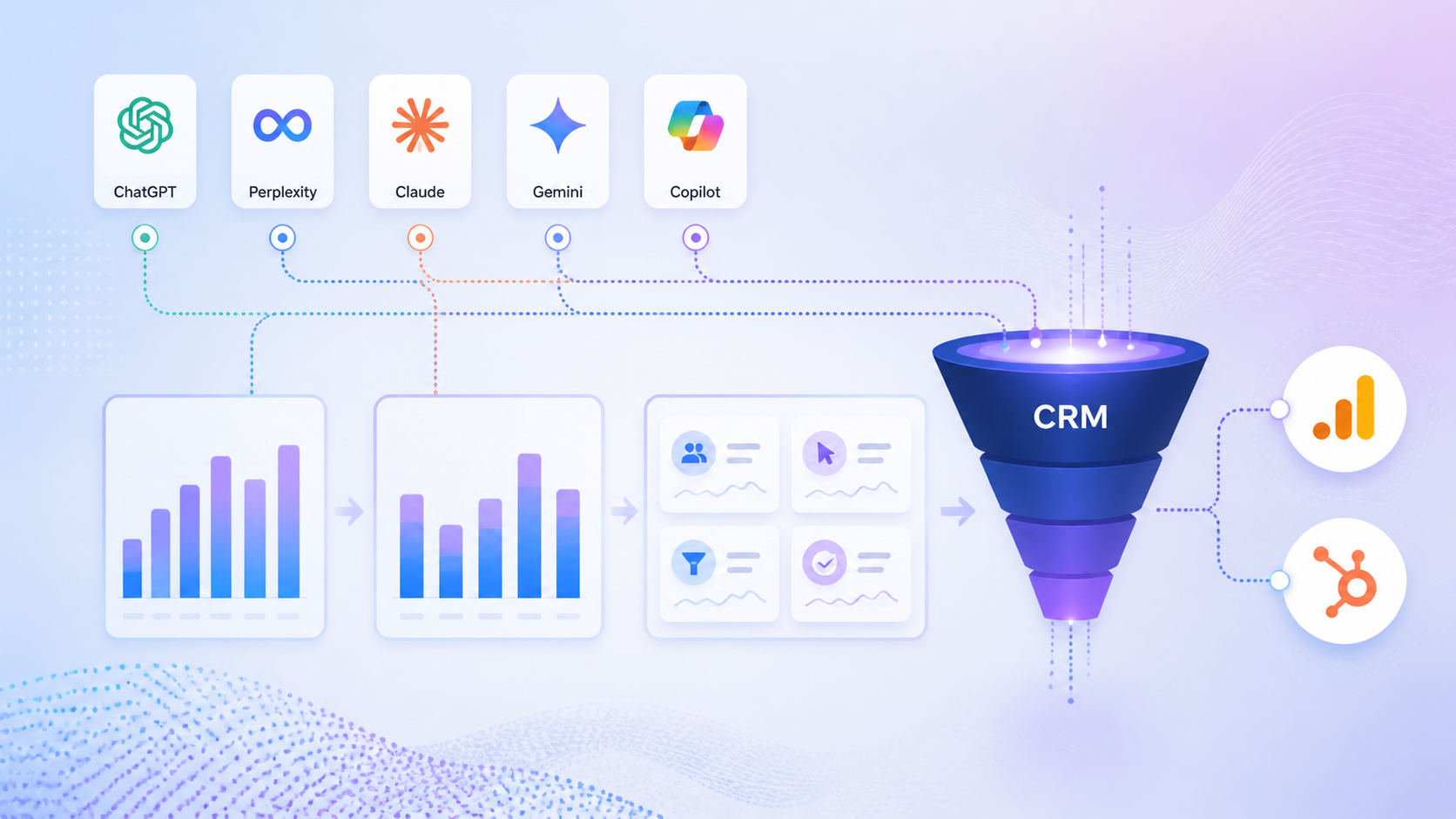
How to Track Which AI Citations Actually Drive Customers: The Attribution Framework That Works in 2026
The New Customer Journey Starts with a Question, Not a Keyword
The way customers find you has fundamentally changed. For two decades, the process was simple: they typed keywords into a search box. Today, they ask a question to an AI. Instead of typing "HVAC repair miami," they ask their phone, "My AC is making a rattling noise, what could it be and who can fix it near me in Brickell?"
The AI does not show them ten blue links. It synthesizes an answer and often cites the source of its information. That citation is the new top search result. Getting your business cited is called Generative Engine Optimization, or GEO. It is not about ranking your website. It is about becoming the trusted source the AI uses to form its answers. Most businesses cannot link an AI citation to a closed deal. Here is a working attribution framework you can deploy this week.
Why Standard Analytics Tools Fail for GEO
Your existing analytics setup, whether it is Google Analytics 4, Plausible, or Matomo, is not built for this new reality. These tools see a visitor arrive from chat.openai.com or perplexity.ai and categorize it as "Referral." This is technically correct but operationally useless.
This simple referral data tells you nothing about the context: * What specific question did the user ask to get the answer that cited you? * Which piece of your content, a blog post, a service page, or a product description, was used in the AI's response? * Were you mentioned alone or alongside three competitors? * Was the citation a direct link, a brand mention, or part of a synthesized paragraph?
Without this context, you are flying blind. You know you received a visitor, but you do not know why or how to get more like them. You cannot optimize a strategy based on a single, generic "Referral" line item.
The Three-Layer Attribution Framework
To properly track GEO performance, you need a multi-layered approach. Each layer adds a level of precision, moving from general traffic to specific, revenue-generating customer queries.
Layer 1: Parameterized URLs (The Foundation)
This is the most direct way to tag traffic from AI citations. It uses the same UTM parameter system that has powered digital marketing analytics for years, but applies it specifically to your content intended for AI consumption.
You strategically add these parameters to the URLs within your website content, especially in articles, FAQs, and data feeds that AIs are likely to scrape and use.
A standard GEO parameter structure looks like this:
| Parameter | Value Example | Purpose |
|---|---|---|
utm_source | ai_citation | Identifies the source category as an AI. |
utm_medium | generative_engine | Specifies the channel. |
utm_campaign | geo_q1_2026 | Groups activity for a specific time or effort. |
utm_content | faq_florida_llc_formation | Pinpoints the exact page or content piece cited. |
Layer 2: Dedicated Landing Pages (Isolating the Funnel)
For your most valuable services, parameters are not enough. You need to create a clean room for attribution. This is done with dedicated landing pages that exist for one purpose only: to be found and cited by AI models.
Here is the process: 1. Identify a high-value service, for example, "cosmetic dental bonding." 2. Create a new landing page: yourdentalpractice.com/ai-bonding-consult. 3. This page is not linked from your main navigation, your footer, or your sitemap.xml file. It is an orphan page, invisible to human users browsing your site. 4. The page contains highly specific, well-structured information about your dental bonding service, answering common questions about cost, procedure time, and durability in the Miami area. 5. You then "seed" this URL in places AIs look for information: your Google Business Profile, industry directories like Yelp, and in the structured data (Schema.org) of your public-facing blog posts.
Now, any and all traffic to /ai-bonding-consult can be attributed to GEO with 100% certainty. There is no other way for a user to find it. You can build a specific conversion funnel from this page, offering an online booking form or a dedicated phone number, and measure its performance without any noise from other marketing channels.
Layer 3: Conversational Data Capture (The Advanced Method)
The final layer moves beyond clicks and pageviews to capture the most valuable piece of data: the customer's original question. This method connects a marketing action directly to a business conversation.
This is not a purely technical solution. It requires a process change.
* For Web Forms: On your dedicated AI landing pages, add one mandatory field to your contact or quote form: "What question did you ask to find us?" * For Chatbots: Configure your website's chatbot to ask this as the first qualifying question. * For Phone Calls: Train your front desk, intake specialists, or sales team. The first question after greeting the caller should be, "So we can best help you, what question did you ask online to find our number today?"
This data must be logged. It goes directly into your CRM (like HubSpot or Salesforce) and is attached to the new contact record.
When a deal is closed, you can look back at the contact's origin and see the exact natural language query that started their journey. You will discover that questions like "best price for 5-ton Trane unit installed in Fort Lauderdale" lead to high-value clients, while "how to fix ac leak" leads to informational seekers. This is the data that allows you to stop guessing and start creating content that attracts customers who are ready to buy.
At Mi Assist AI, we use our on-premise AI assistant, OpenClaw, to analyze these conversational logs for clients. Running on a local Mac Mini, it can process thousands of customer queries securely, identifying patterns and revenue-generating questions without sending sensitive customer data to a third-party cloud service.
Building Your GEO Attribution Stack
You can build a professional-grade stack for this framework with affordable, readily available tools.
* Analytics: Google Analytics 4 is free and sufficient for tracking parameterized URLs and dedicated landing page traffic. For a simpler, privacy-focused option, Plausible ($9/month) is an excellent choice. * CRM / Data Logging: The free tier of HubSpot CRM is more than capable of logging contacts and their initial queries. For a non-CRM approach, a structured Airtable base or even a simple Google Sheet can work for smaller businesses. * Call Tracking: For any business where a phone call is a primary conversion, a tool like CallRail or WhatConverts is non-negotiable. These services start around $45 per month. You can assign a unique tracking number to your AI-specific landing pages. When a call comes in from that number, it is automatically attributed to your GEO campaign in your dashboard. * URL Management: While you can build UTM links manually, a tool like Bitly (starting from free) can help manage them. For a more technical team, self-hosting a tool like Yourls provides unlimited links for free.
A Worked Example: A Doral Real Estate Agency
A commercial real estate agency in Doral wants to attract more international businesses looking to lease warehouse space. They decide to implement the three-layer framework.
The Goal: Attribute signed lease agreements to their GEO content marketing.
1. Layer 1 (Parameters): They write a comprehensive guide titled "A Foreign Company's Guide to Leasing Warehouse Space in Miami-Dade." Every link in the article pointing back to their own service pages is tagged with utm_source=ai_citation and utm_content=foreign_lease_guide.
2. Layer 2 (Landing Pages): They create a dedicated, unlinked page: doralcre.com/ai-warehouse-availability. This page features a simple form to request a current list of available properties over 10,000 sq. ft. It also lists a unique phone number provisioned through CallRail. They seed this URL in international business directories and their company's LinkedIn profile.
3. Layer 3 (Data Capture): The form on the /ai-warehouse-availability page includes the field "What information were you looking for to find us?" Their lead broker is trained to ask callers on the CallRail number the same question. All answers are logged in their HubSpot CRM.
The Results After One Quarter: * Their analytics show 120 visitors landed on their website from links tagged with utm_content=foreign_lease_guide. * The /ai-warehouse-availability page received 45 unique visitors. * Of those 45 visitors, 10 submitted the form and 5 called the tracking number. * Their CRM shows the queries that led to these leads, including "miami warehouse lease logistics south america," "doral free trade zone warehouse cost," and "commercial real estate agent for import export business near miami airport." * Two of these leads result in signed leases, representing over $120,000 in commission. The agency can now prove a direct line from their GEO content to revenue and knows exactly which topics to create more content about.
The Payoff: From Vanity Metric to P&L Line Item
Getting cited by an AI is a vanity metric. It feels good, but it does not pay the bills.
Knowing that AI citations answering questions about "emergency roof repair after hurricane in Naples" generated three jobs worth $47,000 last month is a P&L line item. It is a predictable, measurable, and scalable channel for customer acquisition.
This framework moves GEO from the "experimental" column of your marketing budget to the "revenue-generating" column. It provides the feedback loop necessary to refine your strategy, focus on what works, and eliminate what does not.
This framework requires discipline to set up and maintain. Mi Assist AI implements this attribution model for service businesses across Florida, connecting AI visibility directly to your CRM and revenue.
Book a 30-minute discovery call to discuss building your GEO attribution stack.
Ready to show up in AI search?
We get local businesses cited in ChatGPT, Perplexity, and Google Gemini within 90 days.
Learn About AI Search Optimization