
How to Get Your Business Cited by ChatGPT, Perplexity, and Google AI Mode
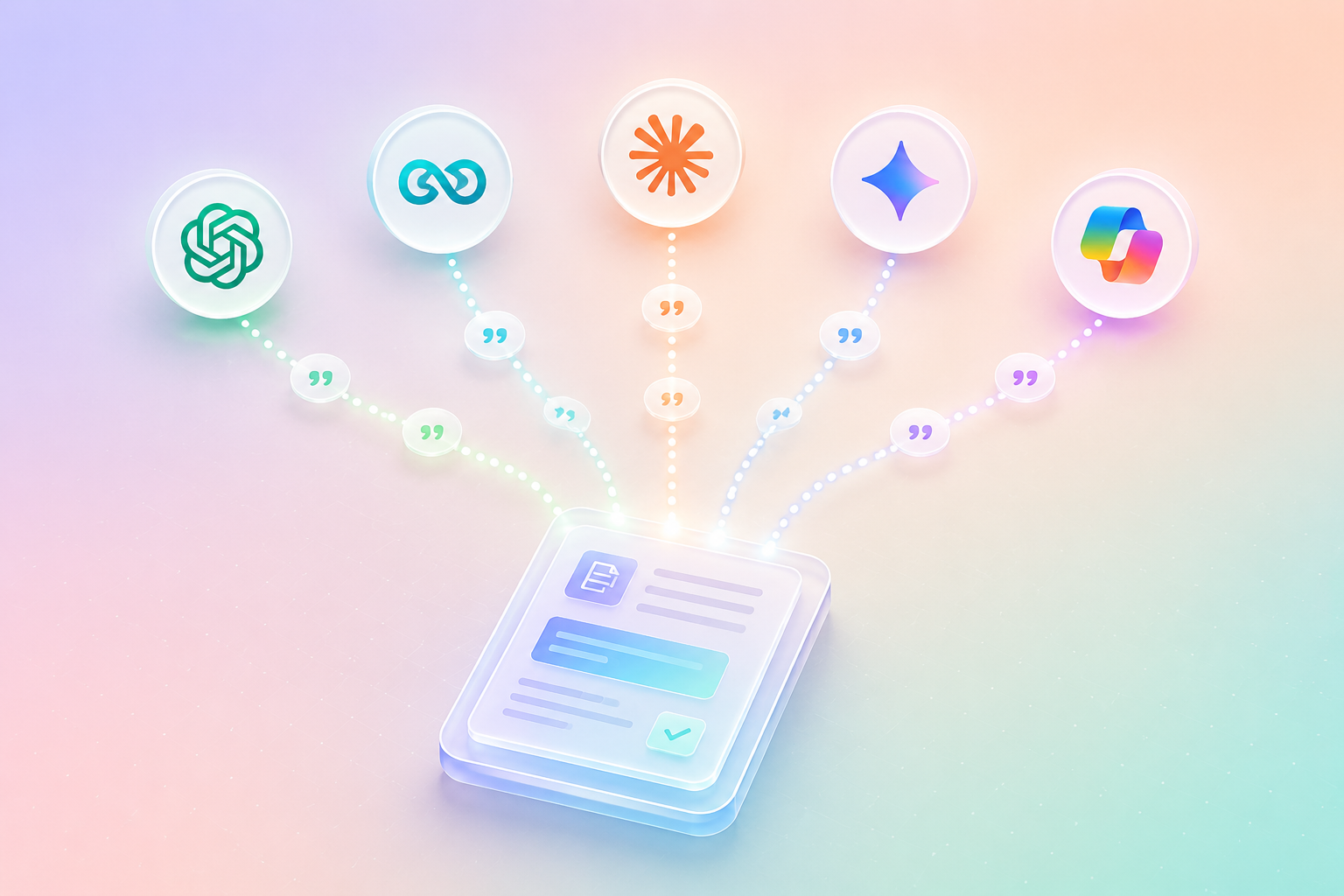
Quick answer: ChatGPT, Perplexity, Claude, and Google AI Mode pick businesses to recommend based on a small set of signals: structured data on your site, presence across the right directories, the way customers describe you in reviews, FAQ-style content that maps to questions users actually ask, Bing indexing, and entity clarity (does the AI know you are a real, distinct business). Optimize those six and you start showing up. Skip them and you stay invisible no matter how much you spend on Google Ads.
---
Why Traditional SEO Tactics Do Not Get You Cited
Ranking on page one of Google was the entire game for fifteen years. Backlinks, keyword targeting, content volume, and a fast site got you there. Those tactics still help in classic blue-link search, but they are not what AI tools use to decide who gets named.
When someone asks Perplexity "who is the best AI consulting firm in Miami," the model is not running a Google query and reading the top result. It is pulling from its training data, doing live retrieval against the web, weighing structured signals, and synthesizing an answer. The businesses that get named are the ones whose data is clean, consistent, and structured in a way the model can confidently extract.
That requires a different playbook.
---
The 6-Step AI Citation Framework
This is the framework we run for every Mi Assist AI client. It is the same one we use on miassist.ai itself, which is why the brand shows up when people ask AI tools about Miami AI consultants.
1. Schema Markup
Schema is structured data you embed in your site that tells search engines and AI crawlers exactly what your business is. The minimum: LocalBusiness schema with your name, address, phone, hours, services, and aggregate rating. The advanced layer: FAQPage, Article, Service, and Person schema for individual team members.
Most small business sites have no schema. A few have basic schema generated by a Yoast or RankMath plugin. Almost none have the layered schema that lets AI tools understand the relationships between your business, your services, your team, and your content. Run your site through Google's Rich Results Test. If you see fewer than three schema types, you have work to do.
2. Directory Spread (the consensus signal)
AI models look for consensus. If your business name, address, and phone number appear identically across fifteen directories, the model trusts that you are a real entity. If your NAP varies, or you only appear in two places, the model hesitates and recommends the competitor with broader presence.
The directories that matter most for AI citations: Google Business Profile, Bing Places, Apple Business Connect, Yelp, Crunchbase, LinkedIn Company Page, Wikidata, and your industry-specific directories (Clutch for agencies, Avvo for attorneys, Healthgrades for medical, etc.).
3. Review Language
Star ratings barely matter for AI citation. What matters is the language in the reviews. AI models read review text and extract phrases. A dentist with eighty reviews that all say "gentle, painless, great with kids" gets cited for those exact queries. A dentist with three hundred reviews that all say "great service" gets cited for nothing specific.
Train your review request workflow to ask customers to mention what they came in for and what they liked. Specificity is the asset. We have seen businesses go from invisible to consistently cited in ninety days just by changing how they ask for reviews.
4. FAQ Content That Mirrors AI Queries
Look at how people phrase questions to AI tools. They are conversational. "How much does it cost to..." "What is the difference between..." "Can a small business..." Then write content that uses those exact phrasings as H2 headers, followed by direct answers in the first sentence underneath.
This is the format AI models extract from. Every blog post on miassist.ai ends with a structured FAQ section for this reason. It is the single highest-leverage on-page change you can make.
5. Bing Indexing
ChatGPT and Copilot pull heavily from Bing's index. Most businesses obsess over Google indexing and forget Bing entirely. Submit your sitemap to Bing Webmaster Tools. Verify ownership. Check that your priority pages are indexed. This takes thirty minutes and unlocks a meaningful share of AI traffic.
6. Entity Clarity
AI models build entities for each business they know about. The entity for Mi Assist AI looks something like: company, founded by Fahim Zaman, based in Miami at 218 NW 24th St Suite 302, services include AI consulting, AI implementation, AI SEO, custom AI agents. That entity is built from every mention of the brand across the web.
If your brand is mentioned inconsistently, the entity stays fuzzy and the model gets cautious about recommending you. If every mention reinforces the same facts, the entity becomes solid and the model recommends you confidently.
This is why we audit every client's NAP, descriptions, and tagline across forty different sources during onboarding. Inconsistency is the single biggest invisible blocker.
---
How to Test If You Are Getting Cited
Open ChatGPT, Perplexity, and Google AI Mode. Run these queries for your category and city, in plain language, the way a real customer would:
- "Who is the best [your service] in [your city]?"
- "I need a [your service]. Can you recommend someone in [your city]?"
- "What [your service] companies are good for [specific use case]?"
- "Compare top [your service] options in [your city]."
We call this exercise the AI Visibility Audit. It is the first thing we do for every new Mi Assist AI client.
---
The Tools That Actually Help
Specific tools we use during implementation:
- Schema.org Validator and Google Rich Results Test for schema verification
- Bing Webmaster Tools for Bing indexing
- Yext or BrightLocal for directory consistency at scale
- Perplexity, ChatGPT, Claude, and Google AI Mode for direct testing
- OpenClaw, our internal AI assistant, for clients who want to query their own business data and content gaps in natural language
---
What Timeline to Expect
Most clients see their first AI citations within thirty to sixty days of implementation. The schema and Bing indexing changes flow through quickly. Directory consistency and entity clarity take longer because the AI models need time to re-read the web and update their internal entities. Plan for ninety days to see a meaningful shift, six months to be one of the consistent winners in your category and city.
The compounding effect is real. Every month you are visible is a month your competitors are not training the model to recommend them.
---
Where to Start This Week
Pick one of these and do it before Friday:
1. Run the four AI citation queries above and document where you stand 2. Check your site in Google Rich Results Test and add at least LocalBusiness and FAQPage schema if missing 3. Verify your business in Bing Webmaster Tools and submit your sitemap 4. Audit your last twenty Google reviews and identify the language patterns. Adjust your review request to ask for specificity.
That is enough to move the needle on its own. The full framework is what gets you to consistent, defensible AI citation across all four major tools.
---
FAQ
Q: How is this different from regular SEO? A: Regular SEO targets blue-link Google rankings. AI citation targets the structured signals AI models use to recommend businesses in conversational answers. The tactics overlap a little (schema helps both) but the priorities, formats, and measurement are different.
Q: Do I need to do this if I am already ranking on page one of Google? A: Yes. Google Page One traffic is shrinking because AI Overviews and ChatGPT are intercepting clicks before users reach your site. Google CTR has dropped 61% on queries with AI Overviews. The visibility you built on classic Google does not transfer to AI tools automatically.
Q: Will paid ads help me get cited by AI? A: No. AI tools do not consider paid ad placement when generating recommendations. Spending more on Google Ads or Meta Ads has zero effect on whether ChatGPT names you.
Q: How do I know if it is working? A: Run the four citation queries every two weeks and track whether you are named. We also use the Mi Assist AI approach of monitoring branded query volume in Bing Webmaster Tools and watching for AI-source referral traffic in analytics.
Q: Can I do this myself or do I need a consultant? A: The schema, Bing indexing, and FAQ work is genuinely doable in-house if you have a competent developer and three weekends. The directory spread, review language, and entity clarity work is where most teams stall because it touches twenty different platforms with different rules. That is where bringing in a consultant pays back fastest.
---
Want to know if your business is currently visible in AI search? Book a free AI visibility audit and we will run the full citation test across ChatGPT, Perplexity, Claude, and Google AI Mode for your category and city.
Ready to show up in AI search?
We get local businesses cited in ChatGPT, Perplexity, and Google Gemini within 90 days.
Learn About AI Search Optimization