
How I Still Use Claude Fable 5 After It Was Removed (And How You Can Too)
On July 7, the smartest AI model I have ever used disappeared from my subscription. Claude Fable 5 was a frontier model available for a limited window, and when the window closed, it was gone. No export button. No "download your model." Gone.
I still use it every day.
Not the model. The model is genuinely gone. What I use is its judgment: the way it read my requests, planned my projects, caught my mistakes, and verified its own work. In the last 24 hours before removal, I made Fable extract all of that into plain files that a cheaper model can load and follow. My business now runs on those files.
This post is the full method. You can run the same play on any strong model before you lose access to it: a subscription downgrade, a model deprecation, a price change, anything.
The idea in one paragraph
A frontier model is expensive to keep, but its judgment can be extracted into files that cheaper models load and follow. Two moves make it work: (1) brain extraction, the strong model writes a "retiring senior analyst" handover explaining how it thinks, and (2) war-gaming. Instead of plans, it pre-simulates your biggest projects move by move, with failure signals and countermoves, so a cheaper model can execute them blind. Then you wire it all into your CLAUDE.md (or whatever instructions file your setup reads) so every future chat gets it automatically.
The key insight: most of what makes a strong model feel smart is not raw capability. It is judgment. Judgment is describable. And anything describable can be written down.
What we actually built, in order
1. Pulled the methods. Extensive research supplied the core moves: the Claude documentation, Anthropic's prompt engineering guides, and a few other sources. Out of that came the war-gaming method and the brain-extraction method, adapted to a real business.
2. The handover doc. The strong model wrote how it reads requests, decomposes problems, verifies instead of pattern-matching, communicates, and self-reviews. Personalized to how I work, not generic advice.
3. War-gamed the 6 biggest projects. Each project became a battle plan: every move with its expected observation, most-likely failure plus its cause plus the countermove, fork triggers, abort conditions, and verification runs.
4. Red-teamed every war-game. The model attacked its own plans, recorded which attacks landed, and patched the docs. This caught real landmines: a test that could have written fake data into a live database, and a hosting choice that would have melted our Vercel bill.
5. Domain briefs. One judgment file per operating area (CRM ops, client comms, websites and deploys, content, ads): the mental models and failure modes that sit above the rules files.
6. Audited every skill with a repeatable loop. Five questions applied to each skill or SOP. It found three places where skills contradicted locked rules, and fixed them.
7. Wired CLAUDE.md. A mandatory section at the top so every model, every chat, loads the standards file and knows when to pull the deeper docs.
The folder structure
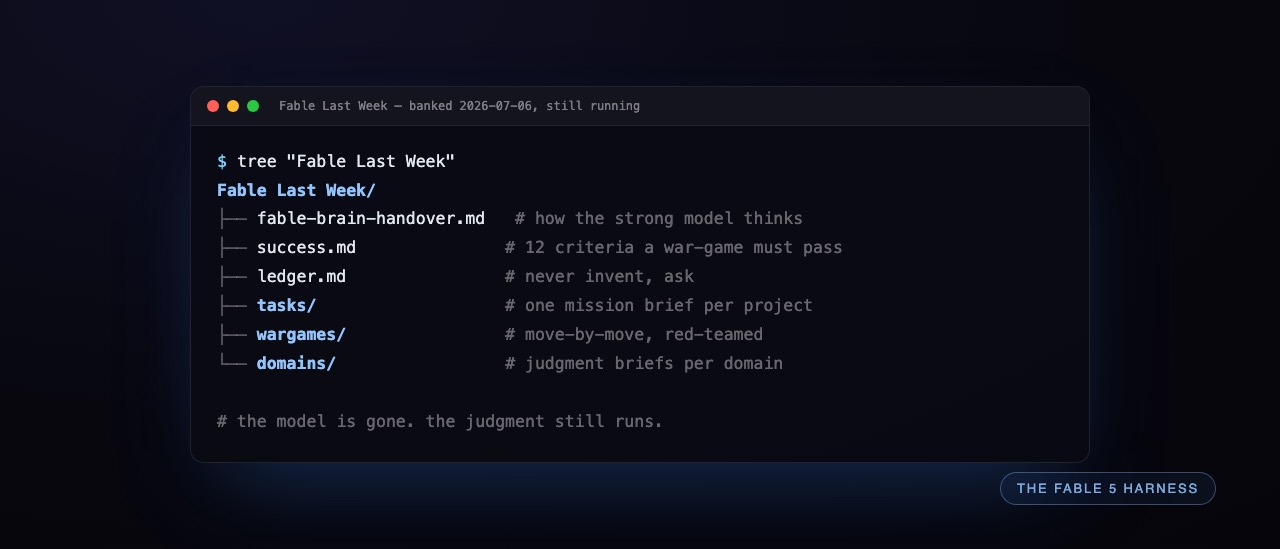
Everything lives in one folder. Here is the exact layout:
Fable Last Week/
  fable-brain-handover.md    <- how the strong model thinks (for the next model)
  success.md                 <- 12 criteria a war-game must pass + the prompt template
  ledger.md                  <- unresolved variables needing MY input (never invented)
  tasks/                     <- one mission brief per project
  wargames/                  <- the battle plans (move-by-move, red-teamed)
  domains/                   <- per-domain judgment briefs + the skill-upgrade loop
Six pieces. The handover is the brain. The war-games are the muscle memory. The ledger is the honesty mechanism: anything the model could not verify gets marked as needing my input instead of being invented.
The 4 prompts (the harness)
The whole system runs on four prompts:
- Rebuild-a-system: takes any repeatable process you run and rebuilds it as durable files a dumber model can execute, with checklists replacing taste and a verification step replacing "use good judgment."
- The brain extraction: makes the strong model write its complete handover as a retiring senior analyst's brain dump to its successor.
- The war-game order: turns any project into a move-by-move battle plan with failure signals, countermoves, fork triggers, and abort conditions, then makes the model red-team its own draft.
- The skill-upgrade loop: five questions that interrogate any skill or SOP and patch what they surface.
The CLAUDE.md wiring
The prompts produce the files. This block makes every future chat actually use them. It sits at the top of the global CLAUDE.md, so it loads for every model, every session:
## Fable-Level Operation - MANDATORY FOR EVERY MODEL, EVERY CHAT
Fable 5 left this subscription, but its judgment is banked. Whatever model is
running: these are behaviors, not capabilities - you can and MUST operate at
this level. The always-on layer is ~/.claude/rules/fable-standards.md
(auto-loads every session). The table below is when to pull the deeper docs.

| Trigger | Do this FIRST |
|---|---|
| Any non-trivial or strategic task | READ fable-brain-handover.md |
| One of the war-gamed projects | EXECUTE the matching wargames/ file - never re-plan from scratch |
| A (VARIABLE:) placeholder | Resolve via ledger.md - ask ONE precise question, never invent |
| Work in a covered domain (CRM, comms, web, content, ads) | READ the matching domains/ brief |
| Writing or judging any plan | Hold it to success.md; attack it, patch it, THEN run it |
| A skill misfires | Run the skill-upgrade loop on it before the session ends |
That table is the difference between "we wrote some docs" and "the docs actually run the business." Without the wiring, banked judgment is a folder nobody opens.
Does it actually work?
Honest answer: it is not the strong model on demand. It is the strong model's judgment frozen at its best, on your specific systems, executable by cheaper models. The war-games are the strongest part. A mid-tier model following a pre-simulated battle plan with failure signals and countermoves genuinely performs above its weight, because the thinking has already been done. The handover doc measurably improves strategic output. The weakest part is novel-in-the-moment judgment on things you never war-gamed. That is what the strong model was for, and no file fully replaces it.
The week after Fable left, the same folder ran client deploys, a CRM build, and a funnel launch on cheaper models, catching mistakes those models would have made on their own. That is the honest bar: not magic, but a real, measurable floor under every model that comes after.
Can you still use Claude Fable 5 after it was removed?
Not the model itself. But if you extracted its judgment into files before losing access, cheaper models can execute that judgment indefinitely. That is what the Fable 5 Harness is: the exact prompts and method for banking a frontier model's judgment before it leaves.
Does this work for models other than Fable 5?
Yes. The method works on any strong model you are about to lose: a deprecation, a subscription change, or a limited-access window. Run the harness while you still have access, and the files keep working after.
How long does the extraction take?
Roughly one focused day. The handover doc and the CLAUDE.md wiring take about an hour. The war-games take the longest, around 30 to 60 minutes per project, because the red-team pass matters as much as the plan itself.
What do you run the files on afterward?
Any capable model. The files are plain markdown. We run them on the standard Claude models in Claude Code, and the whole point of the rebuild prompt is that everything is over-specified enough for a less capable model to follow.
Get the harness
The four prompts above, the wiring, and the folder structure are packaged as the Fable 5 Harness. One email, no payment. If you would rather have us build this kind of system inside your business, book a consultation and we will map it with you.
Ready to show up in AI search?
We get local businesses cited in ChatGPT, Perplexity, and Google Gemini within 90 days.
Learn About AI Search Optimization