
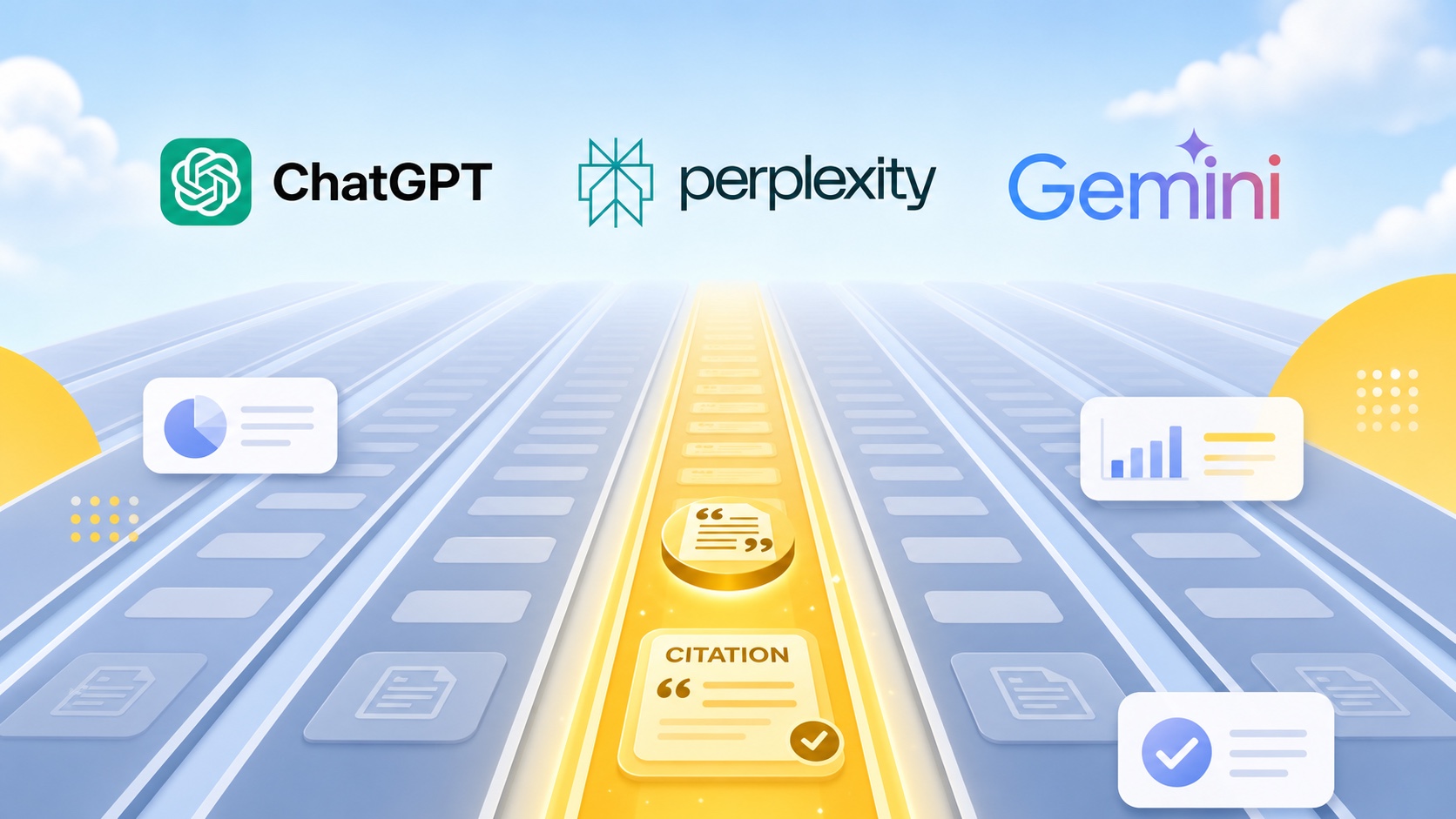
One Niche Per City: Owning a Single AI Citation Lane
The New Map: AI Answers are Winner-Take-Most
A potential customer in Boca Raton asks Perplexity, "who has the best emergency HVAC repair near me?" The AI doesn't show ten blue links. It provides a single, synthesized paragraph recommending one company by name, citing its 24/7 service from their website, a positive review from Yelp, and their service area map from their Google Business Profile. For that customer, in that moment, every other HVAC company in Boca Raton is invisible.
This is the new landscape. For years, businesses optimized for search engines (SEO) to get a high rank on a list. Now, you must optimize for generative engines (GEO) to be the single citable answer. The goal isn't to rank, it's to be quoted.
The opportunity is massive because almost no one is doing it. Data from May 2026 shows that while over 35% of consumers now use AI tools to find local businesses, a staggering 88% of those businesses have no strategy to appear in the results. This is the gap where you can build a defensible moat.
AI-generated answers are a winner-take-most game. Unlike a search results page with multiple options, AI engines like ChatGPT, Perplexity, and Google's AI Overviews synthesize information to present one authoritative response. Research from April 2026 confirms this, finding that 40-55% of all AI citations go to a tiny cluster of fewer than 1,000 domains. There is no second place.
Google's platform update on May 6, 2026, made this explicit. AI Overviews now use inline citations, linking a specific phrase or fact directly to its source. The engine is no longer just recommending a website; it's citing a single, verifiable claim from that site. Spreading your efforts thin is a guaranteed way to be ignored.
Why "One Niche, One City" Is the Only Strategy That Works
Trying to be the authority on "restaurants in Miami" is a losing strategy. The category is too broad, the competition too diffuse. An AI model has no clear, overwhelming signal to latch onto. You get lost in the noise.
But you can become the undisputed, citable authority for "best stone crab delivery in South Beach."
This is the "one niche, one city" framework. You win by narrowing the battlefield to a space so specific that you are the only logical answer. The goal is to build such a dense concentration of proof around a single service in a single location that an AI has no choice but to cite you. This approach aligns perfectly with how AI models evaluate sources, prioritizing deep topical authority and consistent entity signals.
Spreading a budget across five services in three cities ensures you will dominate none of them. Concentrating that same budget on one specific "lane" allows you to build the overwhelming authority required for citation.
Business Example: A Med Spa in Coral Gables A med spa in Coral Gables wants to attract more high-value clients. Instead of targeting the generic and competitive term "med spa Miami," they decide to own the niche of "non-surgical jawline contouring in Coral Gables." Every piece of content, every review request, and every local business listing is focused on this single, specific service. They become the citable expert on that topic in that location, creating a clear signal for AI engines.
The 5-Step Playbook for Owning Your Citation Lane
This is an operator's process, not a theoretical exercise. It requires focus and consistent execution over a period of months.
Step 1: Define Your "One-One" Target
First, choose your lane. It must be a specific, profitable service niche within a single, defined geographic area.
* Bad: "Plumbing in South Florida" * Good: "Tankless water heater installation in Weston" * Bad: "Legal services for businesses" * Good: "Commercial lease review for restaurants in Fort Lauderdale"
The target should be narrow enough to dominate but valuable enough to be worth the effort.
Step 2: Build the Core "Answer Asset"
On your website, create a single, definitive page dedicated to your "one-one" target. This page is not a typical sales page. It is an "answer asset" architected for AI extraction.
* Use Question-Based Headings: Structure the page with H2s and H3s that ask and answer specific questions, like "How Much Does Tankless Water Heater Installation Cost in Weston?" and "What Are the Permit Requirements in Broward County?" * Include Structured Data: Use tables for pricing, comparisons, or timelines. AI models can parse and cite data from tables more easily than from dense paragraphs. * Implement FAQ Schema: Add structured FAQ markup to your page. Pages with FAQ schema are significantly more likely to be cited in AI answers because they directly match the conversational query formats users submit.
This page becomes the central hub of authority that the AI will reference.
Step 3: Establish Entity Consensus
AI models build trust by verifying information across multiple sources. Your business name, address, phone number (NAP), and your "one-one" specialty must be consistent everywhere.
* Google Business Profile: Your GBP is critical. Ensure your primary category is correct and explicitly mention your "one-one" service in your business description, services list, and in regular GBP posts. * Foursquare: This is a non-negotiable step. A February 2026 analysis showed that over 70% of local business recommendations in ChatGPT are pulled from Foursquare's database. * Key Directories: Ensure consistency on Yelp, Apple Maps, and industry-specific directories (e.g., Avvo for lawyers, Thumbtack for contractors).
Inconsistency is a major red flag for AI systems, signaling a lack of reliability.
Step 4: Generate First-Hand Experience Signals
Google's May 6, 2026, update introduced a new "Expert Advice" block in AI Overviews that pulls directly from forums, social media, and review sites. This is a direct signal that AI engines are looking for proof of real-world experience, not just marketing copy.
* Multi-Platform Reviews: Actively solicit reviews on Google, Yelp, and other relevant platforms. Guide customers to mention the specific "one-one" service in their feedback. * Visual Case Studies: Post before-and-after photos or short project videos on your website and GBP. Write detailed descriptions explaining the process and the location (e.g., "Completed this tankless water heater conversion in the XYZ neighborhood of Weston, FL."). * Community Engagement: Participate authentically in local forums where your topic is discussed. Answer questions in neighborhood Facebook groups or on local subreddits.
Step 5: Maintain Content Recency
AI models have a strong recency bias. An analysis of the Perplexity engine in May 2026 found that it gives a measurable boost to content published or updated within the last 30 days.
Set a calendar reminder to make a small but meaningful update to your core "answer asset" every month. Add a new client testimonial, update a pricing table, or add a new question to the FAQ. This simple action keeps the page fresh and signals to AI crawlers that the information is current and reliable.
What This Costs and How Long It Takes
This strategy is not free, but it is a highly-focused investment.
* Timeframe: Do not expect overnight results. Data from May 2026 shows it typically takes 8-12 weeks to see initial improvements in AI citations. Building a durable, consistent presence that reliably generates leads can take 4-6 months of sustained effort. * Cost: The primary cost is focused effort, either from your team or an outside partner. Compare this to the cost of a broad AI marketing software stack, which often runs $300-$500 per month for multiple tools that small businesses struggle to use effectively. Instead of paying for unused software, you are investing in building a permanent, lead-generating asset.
Your Competitors Are Not Doing This
The single biggest advantage you have right now is that your competitors are almost certainly not thinking this way. The May 2026 data is clear: 88% of local businesses have no GEO strategy. They are still focused on old SEO methods, trying to rank for broad keywords, and spreading their marketing budgets too thin.
The window to establish yourself as the definitive authority in your lane is open right now, but it is closing. The businesses that build these focused citation moats in 2026 will become the default recommendations for AI engines, making them incredibly difficult to displace in the years to come.
Business Example: A Real Estate Lawyer in St. Petersburg An attorney wants to attract more clients dealing with property disputes. The market for "real estate lawyer St. Pete" is saturated. She decides to own the niche "quiet title actions in Pinellas County." She publishes the most comprehensive guide on the topic, hosts a webinar with local real estate agents, and gets her guide cited by local property blogs. When a user asks Gemini, "how do I resolve a property line dispute in Pinellas County," her firm's guide is the primary source for the AI's answer.
This is not about finding a secret hack. It is about committing to a disciplined strategy of being the most helpful, authoritative, and focused resource for a specific problem in a specific place.
Mi Assist AI builds these exclusive citation lanes for Florida businesses. We only work with one niche per city to ensure dominant results for our clients. Book a 30-minute discovery call to determine if your niche is available.
Ready to show up in AI search?
We get local businesses cited in ChatGPT, Perplexity, and Google Gemini within 90 days.
Learn About AI Search Optimization