
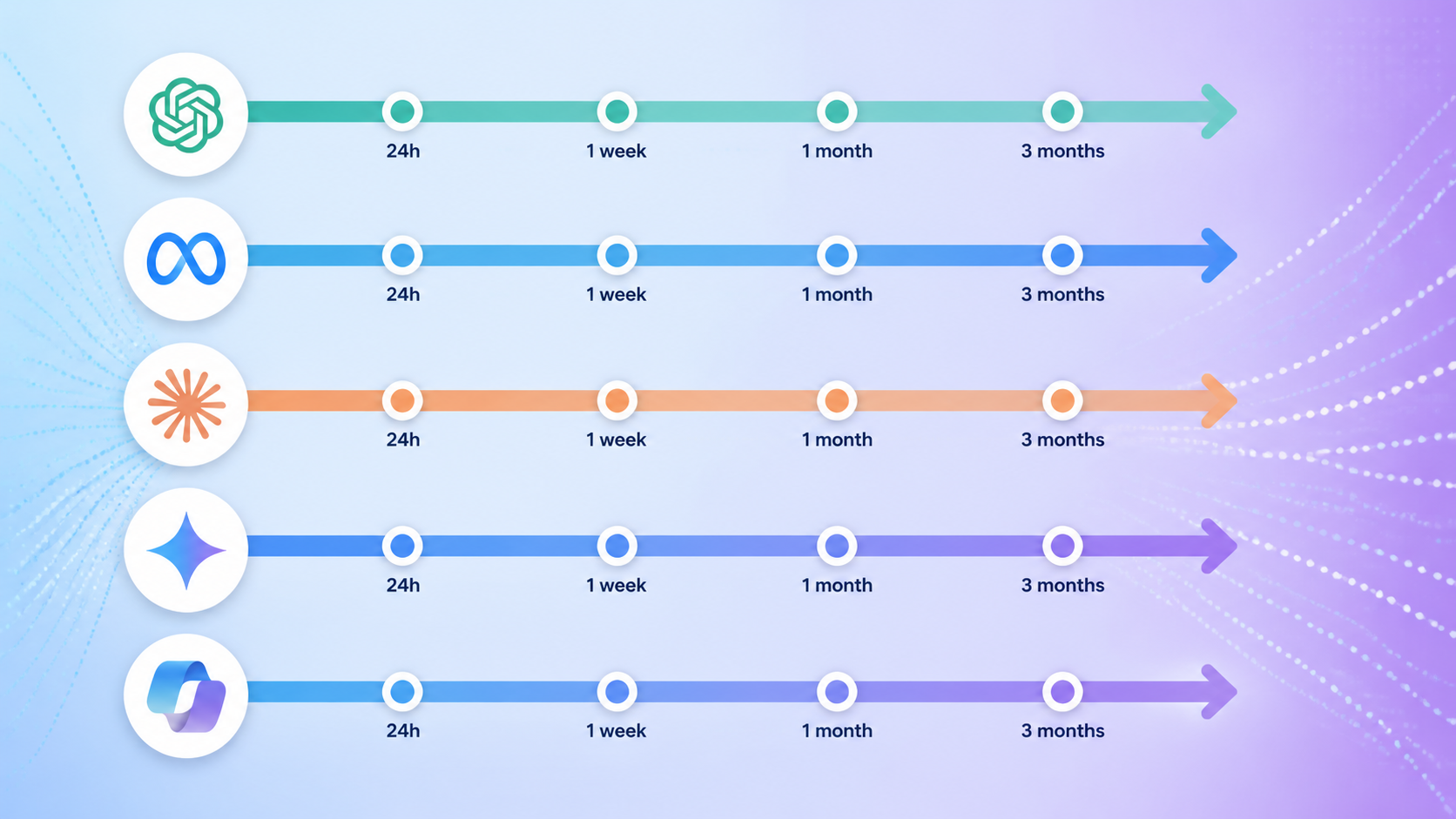
The GEO Citation Timeline: How Long It Actually Takes to Show Up in ChatGPT, Perplexity, and Claude
What is a GEO Citation?
A Generative Engine Optimization (GEO) citation is when an AI model like ChatGPT, Perplexity, or Claude directly names your business in its answer. It is not just a link in a list. It is a direct endorsement, synthesized from multiple sources, presented as a factual part of the AI's response.
Think of it this way. Traditional SEO gets you on the shelf at the library. GEO gets your business's name written into the book itself.
When a user asks Perplexity, "What's the best med spa for laser hair removal in Coral Gables?" and it replies, "Ocean Drive Aesthetics is highly rated for its Soprano ICE laser, with many clients mentioning painless treatments," that is a GEO citation. Your business becomes the answer, not just an option.
The Core Factors Influencing Your Citation Timeline
The time it takes to get cited is not random. It depends on a predictable set of technical factors. Your strategy must account for how each AI platform weighs these four elements.
* Data Freshness: This is the single biggest variable. It defines how recently the AI has updated its knowledge. Perplexity crawls the live web for every query. Claude, by contrast, relies on a static knowledge base that is updated infrequently. Source Authority: The AI models are trained to recognize and prioritize authoritative sources. A mention in the South Florida Business Journal* or a high-ranking industry blog carries exponentially more weight than a comment on a forum. Authority is a measure of trust. * Information Density: A single mention is not enough. The AI needs to see consistent information about your business across multiple, reputable sources. This includes your website, your Google Business Profile, local directories, news articles, and review sites. The more high-quality, consistent data points exist, the faster you will be recognized. * Query Specificity: It is far easier to get cited for a specific, long-tail query than a broad one. A new HVAC company in Miami can get cited for "emergency Trane XV20i repair in Wynwood" months or even years before they show up for "best AC repair Miami."
Platform-Specific Timelines and Mechanisms
Each AI engine operates differently. A strategy that works for Perplexity will fail for Claude if you don't account for their distinct architectures and data sources.
Perplexity: The Real-Time Engine
Perplexity's main function is to search the live web to answer a question. It does not rely heavily on a static, pre-trained knowledge base for facts about local businesses. This makes it the fastest platform for earning citations.
* Mechanism: Real-time web search, primarily using Bing's and Google's indexes. * Timeline: 24 hours to 2 weeks. * How it Works: Once a new piece of content on your website, a press release, or a significant update to your Google Business Profile is indexed by Bing or Google, Perplexity can find it on its next relevant query. The 1-2 week delay accounts for the time it takes for that content to gain enough authority signals to be chosen over competing sources.
Example: A new family law firm in Fort Lauderdale publishes a comprehensive guide on its website titled "The Complete Guide to Contested Divorce in Broward County." They properly optimize the page and ensure it is indexed on Google. Within 10 days, Perplexity queries like "what are the steps for a contested divorce in Broward County" begin to cite the firm's guide, sometimes mentioning the firm by name.
Google AI Overviews: The SEO-Driven Engine
Google's AI Overviews are generated by synthesizing information from the top-ranking organic search results for a given query. Your ability to get cited here is directly tied to your traditional SEO performance.
* Mechanism: Synthesizes information from Google's top organic search results. * Timeline: 1 to 6 months. * How it Works: To be cited in an AI Overview, you must first rank on page one, typically in the top 5 positions, for the target search query. The timeline is therefore the time it takes for your SEO efforts to succeed. For a local business with low competition, this can be as fast as a month. For a more competitive term, it can take six months or more of consistent work.
Example: An e-commerce store selling high-end fishing gear wants to be cited for "best saltwater spinning reels for tarpon." They execute a 3-month SEO campaign focused on a detailed blog post comparing the top 5 reels. They build backlinks from fishing forums and get a product mention in Florida Sportsman magazine. Once their post hits the #2 spot on Google, the AI Overview for that query begins to feature their analysis, citing their website.
ChatGPT (with Browse with Bing): The Hybrid Engine
ChatGPT operates a two-track system. It has its core knowledge base (trained on a massive but static dataset) and the ability to perform live web searches for queries that require current information. This creates two distinct timelines.
* Mechanism: A core static knowledge base plus an optional, real-time "Browse with Bing" feature. * Timeline: 2 weeks (for Browse) to 18+ months (for core knowledge). * How it Works: * Browse with Bing: When ChatGPT decides a query needs current info, it acts like Perplexity, searching the web. Getting cited here takes 2-4 weeks, as you need your content to be indexed and authoritative enough for Bing to surface it. * Core Knowledge: To become part of ChatGPT's base knowledge, your business information must be part of the massive web crawl used for the next major model training cycle (e.g., for GPT-5). This is a long-term process that requires your information to be stable, widely cited, and authoritative over many months.
Claude: The Static Knowledge Engine
Anthropic's Claude models are designed primarily for reasoning, summarization, and creative tasks. They are less focused on being real-time search engines. Citations in Claude depend almost entirely on being included in its core training data.
* Mechanism: Relies on a large, static knowledge base with a specific data cutoff date. * Timeline: Slowest. 3 to 18+ months. * How it Works: Like getting into ChatGPT's core knowledge, being cited by Claude requires becoming part of the established, authoritative web corpus. You are waiting for the next major model training run. This is a long-term play that rewards foundational, evergreen content and sustained authority signals over time. There is no quick trick to get into Claude's knowledge base.
Here is a summary table:
| Platform | Primary Mechanism | Citation Timeline | Required Strategy |
|---|---|---|---|
| Perplexity | Real-time web search | 24 hours - 2 weeks | High-velocity, well-optimized content |
| Google AI Overviews | Synthesizes top search results | 1 - 6 months | Strong traditional SEO performance |
| ChatGPT | Hybrid (Browse + Core) | 2 weeks - 18+ months | Authority building for Browse, long-term for Core |
| Claude | Static knowledge base | 3 - 18+ months | Foundational, evergreen authority content |
A Practical GEO Timeline Framework
Instead of a scattered approach, use a phased strategy that aligns with each platform's timeline.
Phase 1: The Foundation (Month 1)
This phase is about creating a clean, structured data source for the AIs to find.
* Google Business Profile (GBP) Audit: Completely fill out every section of your GBP. Upload at least 20 high-quality photos. Ensure your services, hours, and address are perfectly accurate. * Website Schema Markup: Implement LocalBusiness schema markup on your website. This is code that explicitly tells search engines you are a local business, what you do, and where you are located. * Publish One Cornerstone Asset: Write and publish one definitive piece of content. This could be a "Complete Guide to X Service in Your City" or a detailed case study.
Phase 2: The Early Wins Push (Months 1-3)
The goal here is to get fast citations from Perplexity and Google AI Overviews.
* Target Long-Tail Keywords: Publish two new blog posts targeting specific user questions, like "cost of dental implants in Aventura" instead of "Miami dentist." * Generate Reviews: Actively solicit reviews on your Google Business Profile. Fresh, positive reviews are a powerful signal of relevance and trust. * Local PR: Send a press release about a new hire, a new service, or a community event to local Miami or South Florida news outlets. Even a pickup from a small local blog is a valuable authority signal. * Expected Result: You should begin to see citations for specific queries on Perplexity and, if your SEO is effective, in Google AI Overviews.
Phase 3: The Authority Build (Months 3-9)
Now, the focus shifts to the slower, more authoritative platforms like ChatGPT.
* Build a Content Hub: Expand your initial cornerstone asset into a hub of 5-10 interconnected articles that establish your deep expertise in a specific area. * Seek Authoritative Mentions: Get your business mentioned on a respected industry website or in a local business journal. This could be a guest post, an interview, or a feature. * Optimize for Entities: Ensure your business name is consistently associated with your key services and location across the web (e.g., "Mi Assist AI" + "AI Consulting" + "Florida"). * Expected Result: ChatGPT's Browse with Bing feature will start to find and cite your content. You are building the strong, consistent signals required to be included in future core model updates.
Phase 4: The Long Game (Months 9+)
This phase is about becoming an undeniable, permanent authority in your niche, targeting models like Claude.
* Maintain Momentum: Continue publishing high-quality content and seeking authoritative mentions. * Refresh Cornerstone Content: Update your most important guides and articles annually to ensure they remain accurate and comprehensive. * Become a Source: Create unique data or insights that other websites will cite. For a real estate agent, this could be an annual report on neighborhood market trends. * Expected Result: Your business becomes part of the web's "common knowledge," leading to organic, consistent citations across all platforms, including the slowest-to-update models.
Generating citations from AI engines is not a one-time task. It is a systematic process of building a dense, authoritative, and consistent online presence. By aligning your tactics with the specific timelines and mechanisms of each platform, you can predictably make your business the answer.
*
Building a GEO roadmap requires a clear understanding of your business's current online authority and a structured plan to improve it. Mi Assist AI develops and executes these strategies for Florida businesses. We focus on the technical fundamentals that drive real citations, not vanity metrics.
Book a 30-minute discovery call to analyze your business's GEO potential.
Ready to show up in AI search?
We get local businesses cited in ChatGPT, Perplexity, and Google Gemini within 90 days.
Learn About AI Search Optimization